
Building a Fun and Smart Home with a DIY Smart Doorbell

  Title: Building a Fun and Smart Home with a DIY Smart Doorbell Introduction: In the exciting world of electronics, there's nothing quite as thrilling as creating your very own smart home gadgets. Today, we'll embark on a journey to build a Smart Doorbell using simple and easily accessible equipment like the Arduino Uno, an IR proximity sensor, and a buzzer. This DIY project is not only a fantastic introduction to electronics but also a step towards transforming your home into a tech-savvy haven. So, gear up, young inventors, as we venture into the world of smart homes! Materials You'll Need: 1. Arduino Uno: The brain of our smart doorbell, capable of processing information and controlling the connected devices. 2. IR Proximity Sensor: A nifty gadget that detects the presence of objects in its vicinity. 3. Buzzer: This component will be the voice of our smart doorbell, alerting you when someone approaches. Step 1: Setting Up the Arduino Uno: Begin by connecting your Arduin...
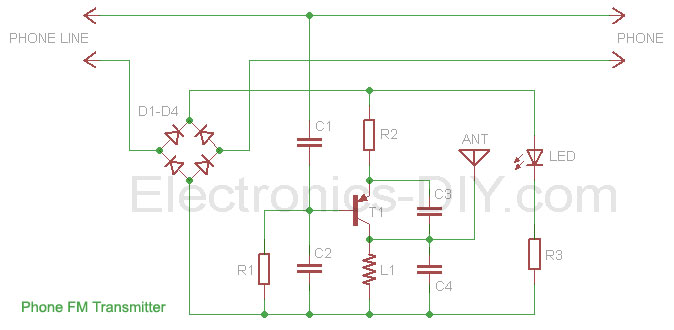
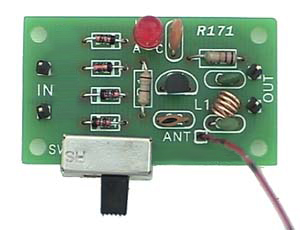
Phone FM transmitter


  Phone FM Transmitter Component List:
T1 - BC559 Transistor
L1 - 4.5 Variable Coil
LED - Red LED
D1-D4 - 1N4004 Diode
C1 - 330pF Capacitor
C2 - 470pF Capacitor
C3 - 12pF Capacitor
C4 - 25pF Capacitor
R1 - 12K Resistor
R2 - 200 Ohm Resistor
R3 - 1K Resistor
ANT - 10cm / 4" wire
  Technical Specifications:
Voltage Supply: Powered by the telephone line
Frequency: 88 to 92MHz
Transmission Range: 100m / 300 feet


Phone FM Transmitter


This Phone FM transmitter connects in series to your telephone line and transmits the telephone conversation over the FM band when you pick up the telephone handset. Transmitted signal can be tuned by any FM receiver. The circuit includes an "On Air" LED indicator and also provides a switch which can be used to turn off the transmitter. A unique feature of the circuit is that no battery is needed to operate the circuit since power is taken from the telephone line. The transmitter uses only a short piece of wire aerial about 4" / 10 cm long to transmit the signal and some of the RF signal is also radiated through the telephone line itself. The circuit might be used to share or record conversations, but is not intended for illegal use.


circuit credit goes to electronics diy.com

Droid Electronics 

Comments

Popular posts from this blog

how to make a lead acid accumulator battery charger

 lead acid accumulator charger circuit introduction: To charge a battery from an A.C source ,first you need a step down transformer, a rectifier and a voltage regulator  to maintain a constant voltage . then it can be used to charge a battery. if a D.C voltage source is available ,you only need a DC-DC voltage regulator , then give the volts to the battery DC VOLTAGE -→→DC VOLTAGE REGULATOR -→→BATTERY As seen in the DC voltage is given to the DC voltage regulator here we use LM317 which is a DC voltage regulator. The regulated DC out voltage is given to battery. There is also a trickle charge mode circuitry which will help to reduce the current when the battery is fully charged.   component of athe battery charger circuit LM317:   LM317 is voltage regulator invented by Robert C. Dobkin and Robert J. Widlar in 1970.the main function of this voltage regulator is to regulate the voltage and give the constant voltage without any noise disturbance; fo...

Flame Detectors Explained

 Flame sensor/ detectors: Flame detectors(sensors) detect the presence of flame.  just as every other sensor operate ; they detect a change in a physical phenomenon and then produce an output signal proportional to the change in the physical phenomenon being sensed or detected. The presence of fire which relates to flames is a physical condition to be watched against  and since this is an unwanted condition , there arise the need to constantly watch(detect) against it and eliminate it as quick as possible when detected . Flame detectors are devices that watch against flames (fire ) , it may also be called a fire detector.  A flame sensor detects a flame but what physical or measureable characteristics of a flame does it detects??. with this question in mind , we need to overview flames , identify the properties of a flame that can be detected /measured / sensed  and work on the best methodology to detect flames. OVERVIEW OF FLAMES A flame is a mixture of reac...

STEM vs. STEAM: Navigating the Confluence of Science and Art

Introduction In today's rapidly evolving world, acronyms like STEM and STEAM have become buzzwords in education and beyond. These acronyms represent two different but interconnected approaches to learning and innovation. STEM stands for Science, Technology, Engineering, and Mathematics, while STEAM adds Art to the mix. In this article, we will delve into the history, goals, benefits, and societal impact of STEM and STEAM education. A Brief History STEM's Roots STEM education has its origins in the mid-20th century when the United States faced a shortage of professionals in science and engineering. The National Science Foundation (NSF) played a pivotal role in promoting STEM fields. STEM education emerged as a way to equip students with the skills needed to excel in these vital areas. STEAM's Emergence STEAM, with its emphasis on integrating the arts, is a more recent development. It is often attributed to the efforts of Georgette Yakman , who advocated for the inclusion ...